

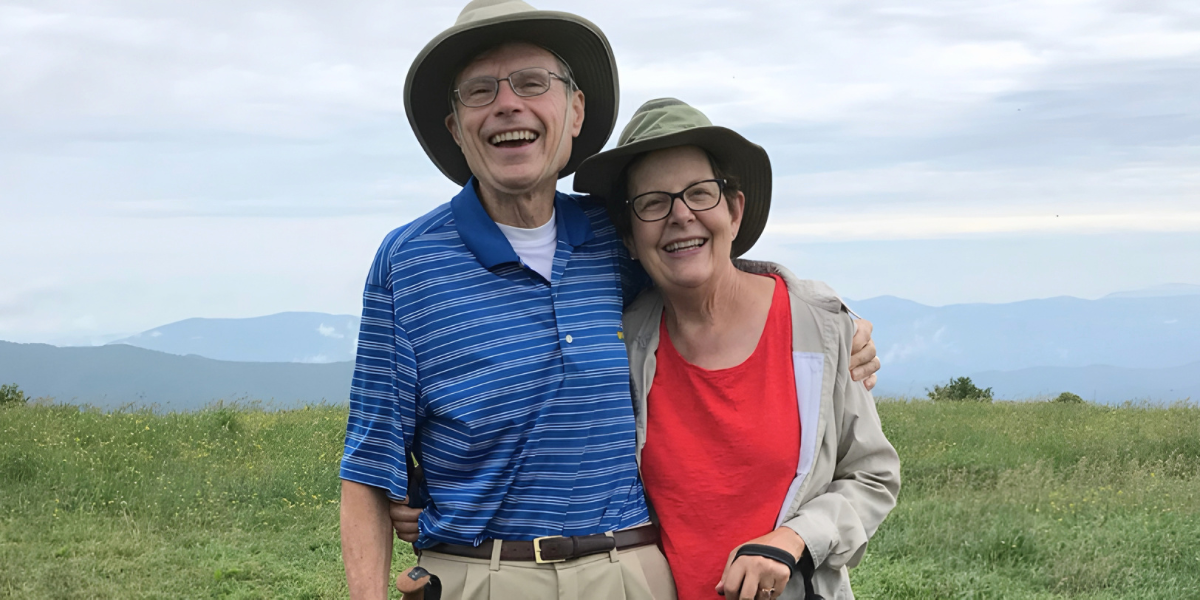
27 May Resident Interview: Martha and Murray Hughes
Posted at 13:21h
in Blog
Where Purpose Leads: The Life of Martha and Murray Hughes
Some lives are shaped not by a single pursuit, but by a steady accumulation of choices to stay engaged, with people, with place and with purpose.
For Martha and Murray Hughes, that pattern has carried them from small-town South Carolina to remote villages in Belize and Chile, across mountain ranges in the United States and Europe and, more recently, into the daily cadence of life at The Woodlands at Furman. At every stage, their story is defined by a shared willingness to step into challenge together.
What emerges is not a life defined by isolated accomplishments, but by connection: to service, to movement and to one another. In parallel with their shared travels and service abroad, Martha and Murray were deeply rooted in their respective careers in South Carolina, where their influence was felt quietly but steadily over time.
A Life Defined by Service
For nearly five decades, Murray practiced real estate law in Pickens, South Carolina, serving the community as an attorney through a career defined by consistency and long-standing relationships. Alongside him, Martha devoted her professional life to education, teaching both music and gifted education across elementary grades while also maintaining a strong presence in church music programs and children’s ministry.
Though their careers differed, both were grounded in long-term service to their communities. That foundation ultimately extended beyond South Carolina, as Martha and Murray pursued opportunities abroad that required adaptability and a willingness to serve in unfamiliar settings.
Their mission began in Belize, not with a grand speech, but with a suitcase full of woodwinds.
“We went to Belize for an arts camp,” Martha shares. “We had a few other people with us. I was teaching recorder and music activities to children and I had a benevolent donor who provided recorders and books for about 150 children. That’s who we served.”
Looking back, Martha is direct about what those experiences required.
“You know, when you do something in a foreign country, you can’t give up. You’re there and you have to keep working,” Martha says.
That sense of persistence also carried forward into their time in Puerto Varas, Chile, where their son helped organize medical outreach efforts in remote villages.
“We did that because our son was there and he had set up a medical outreach opportunity for those villages,” Martha explains. “He brought about 35 doctors and their wives from Augusta, Georgia. He wanted us to come help run a camp because when families came to see the doctors, they sometimes walked 20 or 25 miles.”
Witnessing that level of dedication and deep community need left a lasting impression on her.
“Those experiences really did a lot for my core, who I am and what I want to do for other people,” Martha reflects. “We loved that work. It was a good thing for our marriage, too.”
Since arriving to The Woodlands, Martha and Murray have continued to carry that same spirit of shared purpose into community life. Rather than stepping back into a quieter routine, they have woven themselves into the fabric of daily engagement.
Where Engagement Becomes Community
When asked what ultimately brought Martha and Murray to The Woodlands, the answer traces back to a long-standing connection to Furman University.
“We were both grads,” Murray shares. “I’m ’69, she’s ’70. We’ve lived in Pickens since ’74, so we were only about 17 miles from the back gate the whole time.”
That proximity meant Furman was never far from home. What began as occasional visits for milestones and events gradually became a steady thread in their life.
“We were over here quite a bit,” Murray notes, pointing not only to the campus itself but to its broader community life. “For the athletic events, but also the cultural events, the Furman Singers and the concert choir.”
Those touchpoints, performances and social gatherings, kept them closely connected over the years and deepened their familiarity with The Woodlands.
“We came here with the intention of being part of the community,” Martha states. That mindset quickly shaped the way they approached life after moving in.
Music, in particular, remained a defining link.
“Music has always been part of everything I’ve done,” Martha says, reflecting on a lifetime shaped by teaching and choral work.
After arriving, one of the most meaningful ways she and Murray became involved was through The Woodlands Singers, where music once again became both a creative outlet and a source of connection. They found a kindred spirit in Mark Propst, a neighbor who shared their passion for music and performance.
“When I got there and saw all the people involved, I thought, ‘This is wonderful,’” Martha shares. “I didn’t realize music was such a big part of so many residents’ lives.”
“There was a lot of joy in that,” Murray continues. “Mark was such a great facilitator and director. He made it fun.”
That sense of engagement only deepened in retirement through OLLI programming at Furman, where Martha first began participating in 2010.
“She started hiking with OLLI right after she retired,” Murray recalls. “I picked it up in 2016 and that’s when we started doing backpacking together.”
“It gave me something to look forward to,” Martha confirms.
“And then we would go to OLLI hikes once a week,” Murray adds. “All year long, except for summer. And those would be true hikes in the mountains, not just on a flat trail.”
“We had so many friends who were already here from our OLLI experience, including Bob and Sharon Howell and Greg and Linda Peters,” Murray continues. “We knew a lot of people in our hiking group who eventually moved over here. So we not only knew about The Woodlands, but we also had friends here giving glowing reports.”
The move also carried a more personal significance for Martha.
Following a major health turning point in 2022, the community’s wellness amenities were no longer simply an added benefit. They became central to her independence and long-term quality of life.
“When I found out we were coming here, I had already had a stroke,” Martha reflects. “I felt like it was time to get myself in a place where I could have consistent exercise and opportunities to stay active. I felt like this was the place for me and I’ve tried to take advantage of that.”
And that she did. Martha quickly embraced the full range of wellness opportunities available, often moving seamlessly from one activity to the next. It is not uncommon to find her attending Balance & Core sessions, doing Nordic Pole treks and working regularly with a personal trainer.
“Personally, I’ve been encouraged by the staff,” Martha states.
“Yes, the staff is great here. We need to emphasize that,” Murray confirms.
Murray’s schedule is equally disciplined, anchored by a daily commitment to movement that has become both routine and a personal challenge. Most mornings begin with walking, often for miles at a time, along the Swamp Rabbit Trail, through Furman’s campus and across the familiar paths surrounding the community.
“I have a goal of seven miles a day,” he says. “I don’t always make it, but sometimes I exceed it.”
What began years ago as a habit has evolved into a defining part of his daily practice. When asked what keeps him pushing for that daily milestone, his answer is simple.
“I enjoy it so much,” he says. “That’s why I’m out and moving.”
His excursions often include group nature walks, with visits to places such as Conestee Nature Preserve, Cancer Survivor Park and Clemson’s Botanical Garden, along with other nearby trails and green spaces.
That consistency also recently earned Murray individual recognition during the recent Catch Me If You Can Challenge, a mileage competition among four premier retirement communities that challenged residents to log their walking totals over nine weeks.
Murray finished among the top ten participants in the community, earning a medal for his efforts.
“I’m proud of the award you gave me yesterday,” Murray says with a smile. “I really enjoyed the challenge. I walk a lot anyway, but having something to track and turn in gave me an extra push.”
The competition also became a source of collective pride for residents at The Woodlands. Despite being one of the smaller participating communities, residents logged enough total mileage to earn first place overall, an accomplishment Murray was especially proud to celebrate alongside his neighbors.
“Residents encourage each other too!” Martha adds. “Positive people make a huge difference in a community.”
The Practice of Steadiness
Long before The Woodlands, Martha and Murray were building a quieter kind of resilience together on mountain trails and across hundreds of miles of wilderness where comfort was never guaranteed.
What began as occasional hiking close to home gradually grew into something far more expansive. Over time, the trails carried them through exposed ridgelines in New England, dense Appalachian forests, mountain passes in Spain and long stretches of terrain where weather, fatigue and isolation demanded patience and adaptability.
“We’ve both done part of the AT together,” Murray explains. “From Springer Mountain up to Max Patch, which was almost 300 miles. After that, we’ve been in Mount Katahdin in Maine, the northern terminus.”
Experiences like that became part of the rhythm of trail life. Uncomfortable in the moment, but often remembered later with a sense of fond amusement. One memory from Mount Katahdin in Maine captures this especially well, showing how humor can reframe a struggle.
“My first obstacle was going up a mile slide and there was this ginormous boulder that Murray just hopped right up,” she recalls. “I could not get over that thing until this good-looking man came out of the woods with big arms and a handsome smile.”
She still remembers the exchange clearly.
“I said, ‘I hate to bother you, but could you help boost me up this big rock so I can get started?’ And he said, ‘I’d be obliged, ma’am.’ And he pushed me up and it was like salvation through the woods,” Martha laughs.
Together, they eventually reached the summit, even as younger hikers passed them along the way or turned back before finishing the climb. Looking back, they no longer separate the difficulty from the joy.
“These experiences we’re talking about were not always comfortable when they happened,” Murray reflects. “But those are the experiences we look back on and think, ‘That was really being alive.’”
Beyond endurance, the trail taught them how to adapt, move forward and rely on each other.
“You have to have tenacity,” Murray says. “The older you get, the more you need.”
That grit was not abstract. It was built step by step. On steep inclines, in unpredictable weather, through fatigue and in the decision to continue when turning back might have been easier.
Looking back now, they see those miles not just as adventure, but as preparation for moments that would require the same steadiness. It shaped how they would meet uncertainty when it came later in forms they could not have anticipated.
Rebuilding Strength
In 2022, Martha experienced a stroke that temporarily affected much of her left side and significantly limited her mobility. Recovery in the months that followed required patience, repetition and the humility of rebuilding what had once felt automatic.
Rather than allowing the experience to define her, Martha approached recovery with the same mindset she has carried into the mountains: steady effort and forward motion.
“I remember when I had health bumps, I didn’t know how critical they were going to be,” she acknowledges. “I reflected on how fortunate I had been to that point. How many wonderful things I have done. I’ve not always been weak. I just think of it as a hiccup in life.”
Community also played a defining role in her recovery. Friends who understood both her determination and her limitations stepped in at just the right moments.
“I remember Greg and Linda Peters calling me one time saying, ‘Okay, Martha, we know you haven’t been able to hike, but we’re going to go today.’” That invitation led to a meaningful milestone.
“They went with me the first time back on a big trail. We went to Paris Mountain and hiked up to the fire tower from the parking lot. That was a huge hike for me, but they encouraged me.”
She adds, “I think here, the encouraging nature of people is one of the things that helps you adjust and get through difficulties. I’ve had people on my hall with broken limbs, surgeries, illnesses, whatever it may be and there’s this constant parade of people checking on them. I think that’s all part of community.”
Happiness, Joy and Perspective
A central thread in Martha and Murray’s philosophy is that happiness is not something created by circumstance. It is something carried within a person long before any change in setting. For them, the move to The Woodlands was not a turning point in emotional well-being, but a continuation of a life already grounded in contentment and shared meaning.
“People say, ‘Are you happy?’ And I tell them, ‘I was happy before I got here,’” Martha says with a smile. The decision to relocate was never driven by a search for fulfillment, but by timing and shared intention.
“Murray and I had made these plans together and we were able to come here at this point in our lives. We were happy when we arrived,” she says. “I did not expect The Woodlands to make me happy. That’s not The Woodlands’ responsibility.”
Instead, Martha views joy not as a product of her environment, but as a choice from within.
“I think that’s something people need to understand. Happiness is an intrinsic quality. It doesn’t rely on somebody else.” Even within a supportive community, Martha is careful to distinguish encouragement from outcome.
“Now, you’ve helped make me stronger,” she notes. “But whatever motivation or suggestions you give me, I still have to choose to do those things.”
If Martha describes happiness as steady and foundational, Murray draws a distinction that gives their philosophy its depth. Happiness, in their view, is the baseline. Joy is something more resilient. It persists even when circumstances are difficult.
“You can still live with joy even in difficult circumstances,” Murray reflects. “You lived it with joy even though you weren’t feeling too good at the time.”
Seen in full, their story returns to where it began. From South Carolina to distant villages, from mountain trails to community life, the settings have changed, but the throughline has remained.
A steady commitment to purpose, carried forward together across every season of life.